One short walk a season, a few one-minute habits, and the tools stop rusting, the wood stops rotting, the food stops spoiling, and the mice stop coming in.
$29 · Instant download · 7-day money back guarantee
Get the SystemPay once. Yours forever. Print as many copies as you like.
Nobody sends you a bill for the quiet losses.
The hand plane going orange on a nail in the shed. The shovel handle splitting in the sun. The bag of potatoes sprouting soft under the sink. The damp creeping into the cellar corner. The mouse walking in through a gap the width of a pencil, rent free, into a full pantry.
A bill you would argue with. A quiet loss you just replace, and replacing it feels normal. New pruners, thirty dollars. New handle, fifteen. Groceries thrown out, ten here and ten there. A pest man, a hundred and fifty. Ask any household to add up a year of it and they cannot, because it never arrived as one number. It arrived as a hundred small ones.
Here is the part that ought to make you angry: almost none of it was necessary.
You already know this is true, because you have seen it in your own house.
You have opened a toolbox in spring and found orange where there was steel in the fall.
You have thrown out a tomato that turned mealy in the refrigerator and never known that the refrigerator did it.
You have set traps for a mouse for three winters running and never once walked the outside wall to find the door it uses.
You have watched a good chair go gray and soft on the porch, one winter too many, and told yourself that is just what happens to wood.
None of that is what happens. That is what happens when nobody walks the house.
He owned tools for sixty years and a house for fifty, and the shed outlived him in working order.
He never repaired much because he walked. Every season, the same slow round: the shed, the cellar, the pantry, the foundation, the porch. Not looking for work. Looking for the beginnings of work. The shadow of rust on a saw. The board where rain sat too long. The gap by the pipe that was not there last year.
He fixed each one while it was a minute's job and a dollar's cost, and so the big repairs, the ones with real money in them, simply never arrived.
That round is this book.
Not ninety-three tricks to memorize. One repeatable walk, four times a year, and the plain knowledge of what to do with whatever the walk finds.
There is nothing clever in it. That is exactly why it works, and why it kept working for the two hundred years before anyone thought to sell you a subscription instead.

Every home in America leaks in the same five places, because the same crew is at work on all of them: water, air, and time, on anything left unwatched.
I
Every tool, blade, and pan you own is trying to return to the dirt it came from.
Inside: the one-minute habit that ends rust before it starts, the three-way rust triage so you never again throw out a tool that had thirty years left, the two-dollar vinegar bath, sharpening angles for every edge in the house, and how to bring a rusted cast iron pan back to black.
II
Wood does not wear out. It dries until it cracks or drinks until it rots.
Inside: the yearly oiling that keeps hundred-year-old axes on their first handles, how to read a loose head and a cracked haft honestly, and the plain rules that keep porch, posts, and furniture out of the rot.
III
For most households this is the biggest leak of the five, and the least seen.
Inside: the full pantry map of what belongs in the cold and what the cold is quietly ruining, what must be kept apart from what, the sealed shelf that ends pantry moths, and the rotation habit that stops good food from being discovered in the garbage.
IV
The mother of the first two leaks and the landlord of the fifth.
Inside: the six places water hides, how to hunt them with your eyes, your hand, and your nose, and four cures, three of which cost almost nothing.
V
Mice, moths, and ants do not break in. They walk in through doors you have not found, to eat food you have not sealed.
Inside: the pencil walk that finds every door, the copper-and-cloth method that closes them for years instead of weeks, why steel wool fails, why the plug-in sound machines are worthless, and the order of operations that keeps you from sealing mice inside your own walls.
The Book
The complete illustrated system, five parts, seventeen numbered methods. Every one in the same plain shape: what you do, why it works, what it costs and saves, and Jonas's honest word on what the method cannot do.
The Keeper's Round
Four walk sheets
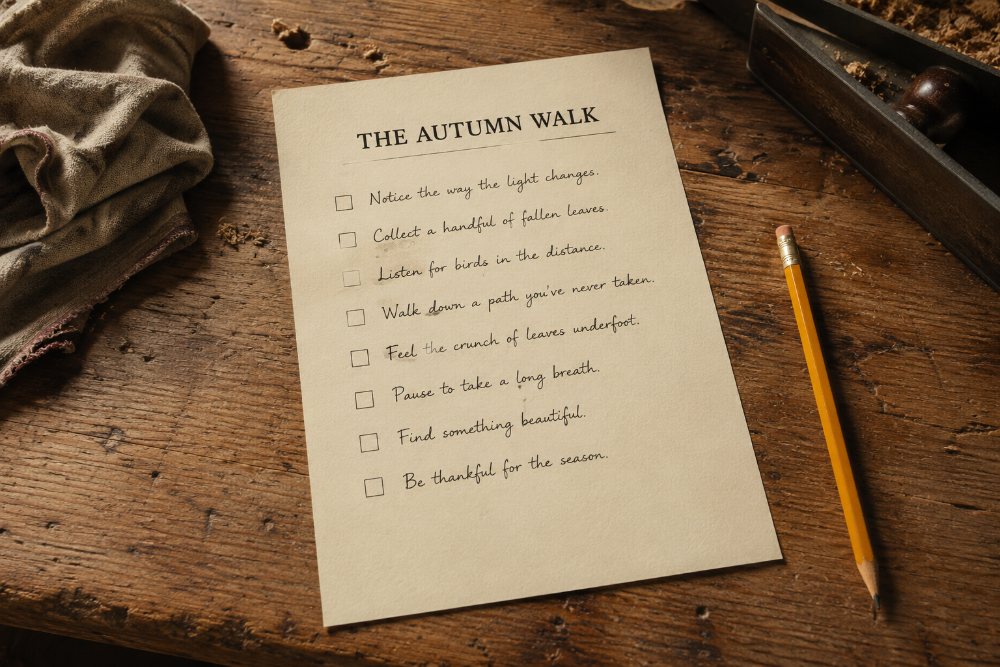
Spring, Summer, Autumn, Winter. One page each, built to print. Take one, take forty minutes, walk your house. This is the engine of the whole thing.
Six Reference Cards
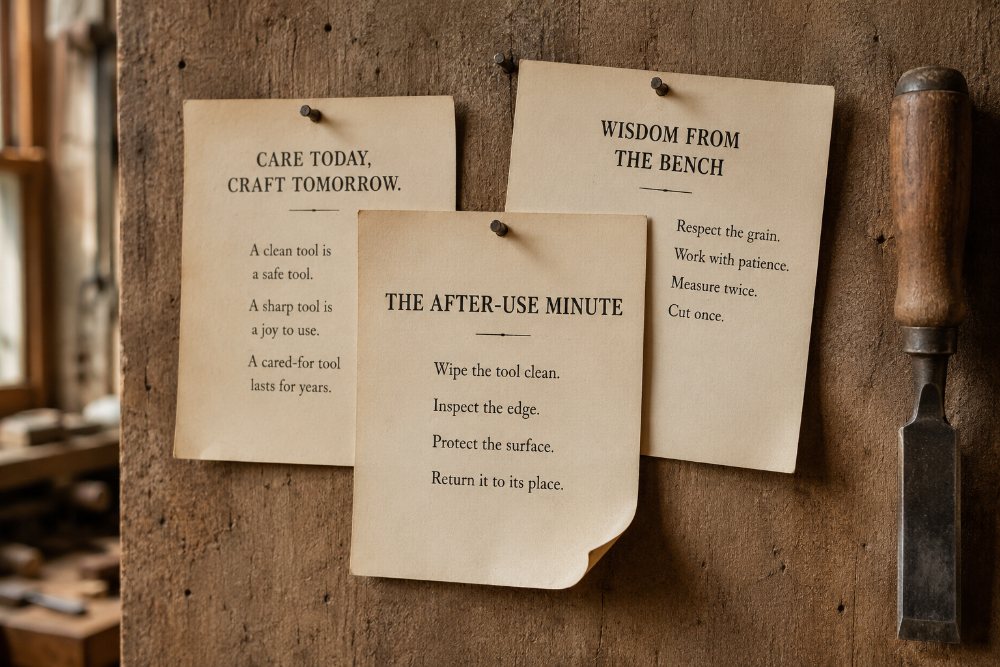
Print them and hang them where the work happens. The After-Use Minute for the shop wall. The Kitchen Steel Minute for inside a cupboard door. Rust Triage. The Pantry Map. What Goes On What. And When to Let It Go, for the honest corner of the shop.
Set in Large Type Throughout
The entire book is 17 point on cream, with wide leading and dark ink. No squinting, no separate edition needed.
The Sources
Every substantial claim in this book is traced to where the knowledge stands: USDA food storage guidance, EPA moisture and mold guidance, CDC and extension service rodent guidance, the Federal Trade Commission on those sound machines, the National Fire Protection Association on oily rags. Listed plainly in the back, so you can check any of it yourself.

One of the four walk sheets

Cards for the wall and the cupboard door
This is where I part company with most of what is sold to people our age.
Every method has its limits, and I tell you the limits.
In plain words, in the same place every time. A method sold with no honest limit is a method sold by a salesman.
Where a job is past this book, I say so.
Mold bigger than a card table, water at the wiring, rot in the bones of the house, a cracked axe head: those get a plain “this is not yours to fix, and here is why.” I would rather lose the sale than have you hurt in your own cellar.
There is no medicine in this book.
No remedies, no cures, no folk doctoring. I am a carpenter, not a physician, and the moment a household book starts prescribing is the moment you should close it.
Nothing here needs special hands or strength.
No power tools required, no ladders past the first step, no strength beyond carrying a flashlight and a pencil.
This is for you if
You own a home, a shed, or just a kitchen and a closet full of things worth keeping.
You would rather spend a Saturday morning than a service call.
You are tired of internet advice that cannot tell you where it came from.
This is not for you if
You want ninety-three tricks to skim and forget.
You are looking for major renovation or repair instruction.
You want somebody to tell you a house can be made maintenance free. No such house was ever built.
Price and Guarantee
$29
Instant download. Yours forever. Print it as often as you like, for your own house and your children's.
The plain math
One hand plane not lost to rust, one shovel handle not replaced, one week of groceries not thrown away. Any one of those covers it.
7-day money back guarantee
Read it, walk your house once, and if it did not give you anything worth keeping, reply to your receipt email and every dollar comes back. No forms and no questions from me. The book stays on your shelf either way.
Emailed to you within 60 seconds
Is this not all free on YouTube?
Much of the knowledge is, on my channel and elsewhere. What is not free is the order of it: what to check, when, in what sequence, and what to do the moment you find it, all in one place, on paper, in your hand while you are standing in the shed. Scattered knowledge is not a system.
I have kept house for forty years. Will I learn anything?
You will know a good deal of it, and I would think less of the book if you did not. What most folks find is not new facts but the round itself, plus a handful of corrections: the tomato that should never have gone in the cold, the steel wool that was never going to hold a mouse out, the water displacer spray that was never a keeper.
How long does the walk take?
About forty minutes, four times a year. Most of what you find is fixed on the spot in a minute or two.
Do I need to buy anything?
Mineral oil, white vinegar, boiled linseed oil, copper mesh, a sharpening stone, and some jars. Nearly all of it is a few dollars at the hardware store, and you likely own half of it already. Nothing in this book requires a purchase over about twenty-five dollars.
Is it a physical book?
No. It is a digital book, PDF, delivered the moment you buy. Read it on a phone, tablet, or computer, or print the whole thing at the kitchen table. The walk sheets and cards are built for printing.
Is the type easy on the eyes?
Yes. The whole book is set in large, high-contrast type, 17 point, with generous spacing. There is no separate large print edition because this is the large print edition.

I am a carpenter in Holmes County, Ohio, sixty years old this spring, and I keep a house, a shed, and a garden the way my father kept his.
On my channel I show the old ways and tell the plain truth about which of them work and which are only stories. That is the whole of what I do. I have no products to push and no trade in fear.
This book exists because folks kept asking me to write it down. So here it is: the round my grandfather walked, put in order, checked against what we know now, and finished.
Water, air, and time are patient, but they are slow.
A householder who looks four times a year beats them four times a year, every year, for the price of a rag, a jug of vinegar, and forty minutes of a Saturday.
You already own the house. You already own most of the tools. What you have been missing is the walk.
Pay once. Yours forever. 7-day money back guarantee.
P.S.
A man wrote to me on the channel not long ago. He is seventy-two, and he told me he still has many of his father's tools, and that he thinks of him every time he picks one up.
That is the real reason for all of this. The savings are real and I have counted them honestly on every page. But what we are actually doing is keeping good things alive a little longer than we are, and handing them on in working order.
Keep your steel dry, your wood fed, your pantry sealed, and your walks regular.
God keep you, friend.
Jonas
Holmes County, Ohio